
Nuance

⚖️ From the Archive
This piece from 2024 came out of frustration. Not with disagreement itself, but with how quickly disagreement turns into tribal warfare. I was trying to understand why nuanced conversations feel so rare, even when people’s actual end goals are often closer than they appear.
Here I explore social identity theory, the amygdala’s threat response, confirmation bias, moral outrage, and the role of social media in amplifying certainty over curiosity. I also lean on an old insight from Aristotle, whose view of virtue reminds us that patience, humility, and courage are prerequisites for real dialogue.
Reading this now, I see how much of my later writing on non-judgment, narrative identity, and stepping out of autopilot was already forming here. The core idea still holds. When our beliefs fuse with our sense of self, disagreement feels like danger. And when the nervous system feels threatened, nuance doesn’t stand a chance.
If anything, the need for this conversation has only grown.
(Originally posted on LinkedIn in 2024)
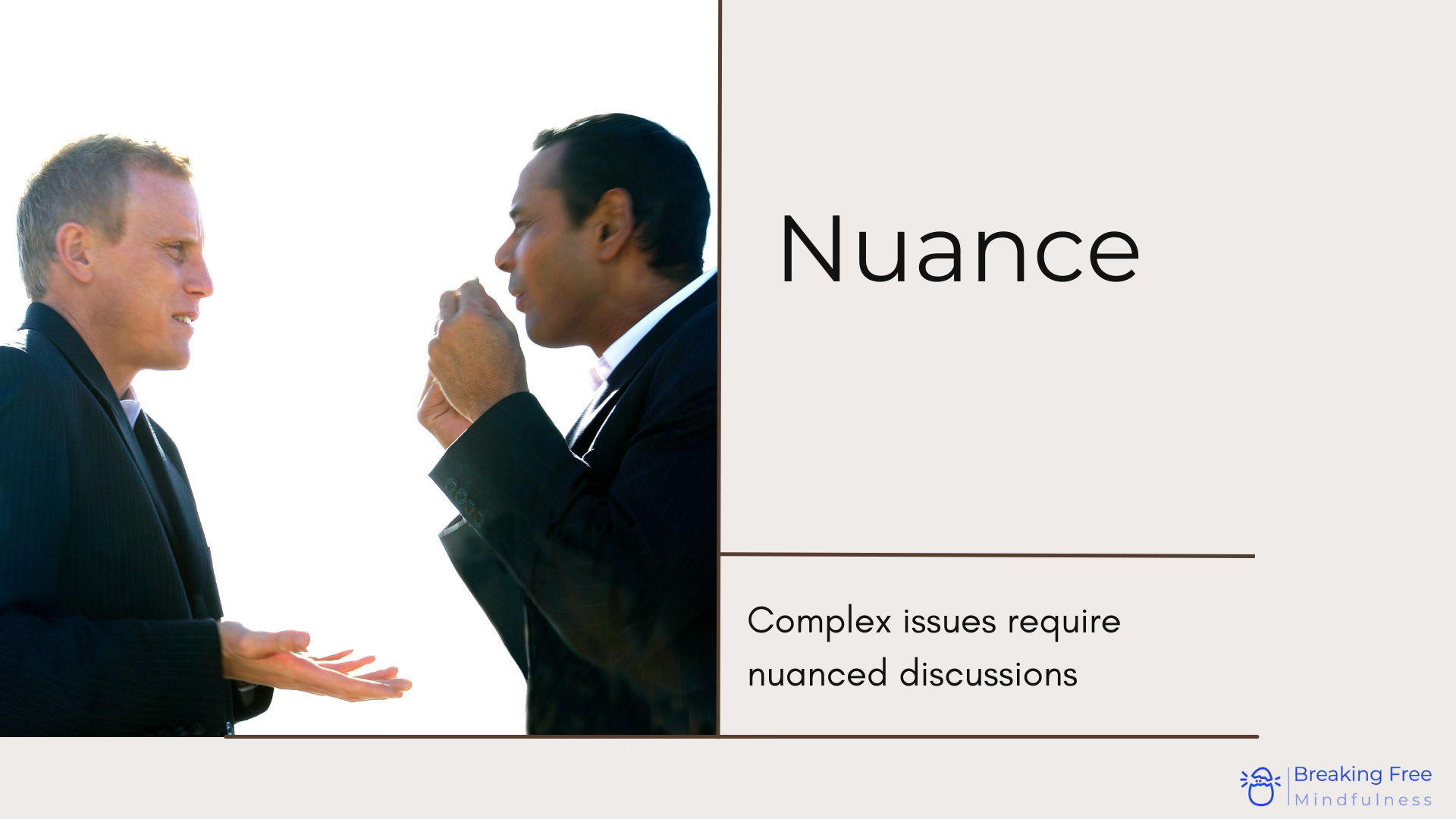
I don’t have to tell you we are living in a hyper-politicized world. It’s hard to even have a conversation without it escalating into an argument, especially on controversial (and sometimes even benign) topics. What’s frustrating is that there often isn’t a credit card’s worth of space between the desired end goals on either side of the argument. A lot of tough topics are complex and nuanced, and we as a society seem to have lost the ability to have those sorts of nuanced discussions. What happened to civil discourse?
I can’t help but blame a cocktail of factors, from the wiring of our brains to social media. Let’s look at a few factors.
Social Identity
Social Identity Theory is a psychological framework that explores how people’s self-concepts are shaped by their membership in social groups. It looks at how group dynamics influence behavior, attitudes, and perceptions of others.
The mind builds all sorts of heuristics to save energy. Socially, we categorize ourselves and others into various groups based on characteristics like nationality, ethnicity, political affiliation, religion, or even hobbies and interests. This categorization simplifies the social world by organizing people into groups, but it also leads to the creation of “in-groups” (the groups we belong to) and “out-groups” (those we don’t belong to).
Our social identity is a strong part of our own self-concept. When we identify strongly with a group, that group becomes a significant part of how we see ourselves. For example, being a member of a particular political party might become a core part of a person’s identity. We tend to defend those stories with vigor, so when someone challenges our political views, for instance, it can feel like a personal attack.
Fight or Flight
What can start as a social identity effect can be amplified by natural characteristics of the brain. The amygdala is a small, almond-shaped cluster of cells located deep within the temporal lobes of the brain, one on each side. It’s part of the limbic system, which is involved in processing emotions and memory. It’s also the part of your brain that’s constantly on the lookout for danger. This certainly came in handy back in the day when we were dodging predators, but today the amygdala can get fired up even when Uncle Bob starts ranting about his favorite conspiracy theory at Thanksgiving dinner.
When the amygdala senses a threat (real or imagined), it kicks off the “fight or flight” response. This is why political conversations often feel like a battle, with each side retreating to the safety of their trenches, ready to lob ideological grenades. Understanding nuance takes time and energy, not something consistent with a hormonal response telling you to fight or run away.
Besides the neurochemical effects, there are numerous logical fallacies we fall prey to. I’ve talked about many of them before. Confirmation bias is a big one – your brain’s way of saying, “I’m right, and here’s more evidence to prove it!” As a result, we seek out information that aligns with our pre-existing beliefs, making it easier to dismiss anything that doesn’t fit neatly into our worldview.
Truth and Virtue
This is probably a topic in and of itself, but the concept of “truth”, surprisingly, has become vague. There seem to be less and less objective truths. As an aside, I once had a long argument over whether 2+2=4 with someone, and it went down a rathole of cultural discussions, debates about numbers being social constructs that we all tacitly agree on, etc. Arg.😡
Anyway, today truth is often seen as subjective, a malleable concept that varies from person to person like an ill-fitting sweater. This shift has made it increasingly difficult to engage in meaningful discussions because, let’s be honest, if we can’t even agree on the basic facts, what’s left to talk about?
I wrote about virtue recently; the Aristotelian view of virtue emphasized the importance of qualities like patience, humility, and courage in discussions. These virtues allow for the kind of nuanced conversations where people can disagree without demonizing the other person.
In today’s discourse, those virtues seem to be in short supply. Instead of patience, we’ve got knee-jerk reactions. Instead of humility, we’ve got a lot of shouting. And courage? Well, it takes a brave soul to suggest there might be more than one side to a story in this climate.
Social Media
Social media has figured out that the best way to keep us engaged is by showing us more of what we already agree with. So, we end up surrounded by people who think just like us, reinforcing our beliefs and making it even harder to understand where the “other side” is coming from. It’s like living in a bubble where everyone tells you how smart and right you are–until that bubble gets popped by an opposing opinion, and then it’s war.
Of course, we can’t forget the role of culture and technology in this whole mess. We live in a world of instant gratification, where patience is a virtue few seem to espouse. Social media platforms encourage quick, reactive responses—often rewarding the most extreme or emotionally charged takes. Why craft a thoughtful, nuanced argument when you can just drop a snarky tweet and watch the likes roll in?
“We must admit that our opponents in this argument have a marked advantage over us. They need only a few words to set forth a half-truth; whereas, in order to show that it is a half-truth, we have to resort to long and arid dissertation. - Frédéric Bastiat
Moral outrage has become the currency of the internet, and it’s contagious. When we see others expressing outrage, we’re more likely to join in. It’s a feedback loop that amplifies extreme views and drowns out the quieter, more measured voices. Nuance just doesn’t get the same engagement.
What now?
Given all this, it’s going to take effort to get to place where we can have the sort of complex, nuanced discussions that are necessary to make progress on our toughest challenges. Learning to actually listen is critical, and being aware of our own self-concept and how it feels when it is challenged can help negate some of the automaticity of our reactions. I seem to talk about this every week, and it’s so important, this stepping back from autopilot and recognizing what is a narrative we have built about ourselves and our world, and what is actually going on. They are simply not the same thing, and you won’t get there without some sort of mindfulness or other reflective practice in your life.
I spoke a few weeks ago about the lost art of rhetoric, and that’s another skill to build. The ability to construct a cogent argument and defend it in a constructive fashion is a powerful skill. Still, most people still won’t want to engage in that sort of discussion since it is so much easier to shout inanities or reiterate their positions.
Maybe, just maybe, it means spending a little less time on social media and actually talking to the people around you. It’s much harder to be a jerk when you don’t have the artificial distance of the internet protecting you.
Let’s hear it in the comments about your experiences having tough conversations!
-Scott