
Is Reality an Illusion?

🧠 From the Archive
I wrote this after briefly mentioning that the brain constructs reality moment by moment and realizing that idea deserved its own deep dive. What started as a philosophical thought experiment, the brain in a vat, quickly turned into a tour through Bayesian reasoning, medical test probabilities, perceptual illusions, virtual reality, and the simulation hypothesis.
The core claim is simple but destabilizing. The brain is not passively recording the world. It is predicting it. Updating it. Filling in gaps. What we experience as solid reality may be closer to the brain’s best ongoing guess.
Reading this now, I can see how it set up many of the pieces I’ve explored since, especially around time perception, free will, and the constructed sense of self. The questions still stand. If experience is a model, what exactly are we so certain about?
(Originally Posted on LinkedIn March 2025)
Are We Just a Brain in a Vat?
In last week’s article I mentioned in passing that the brain is constructing reality moment by moment. This idea is so fundamental that it deserves a deeper dive.
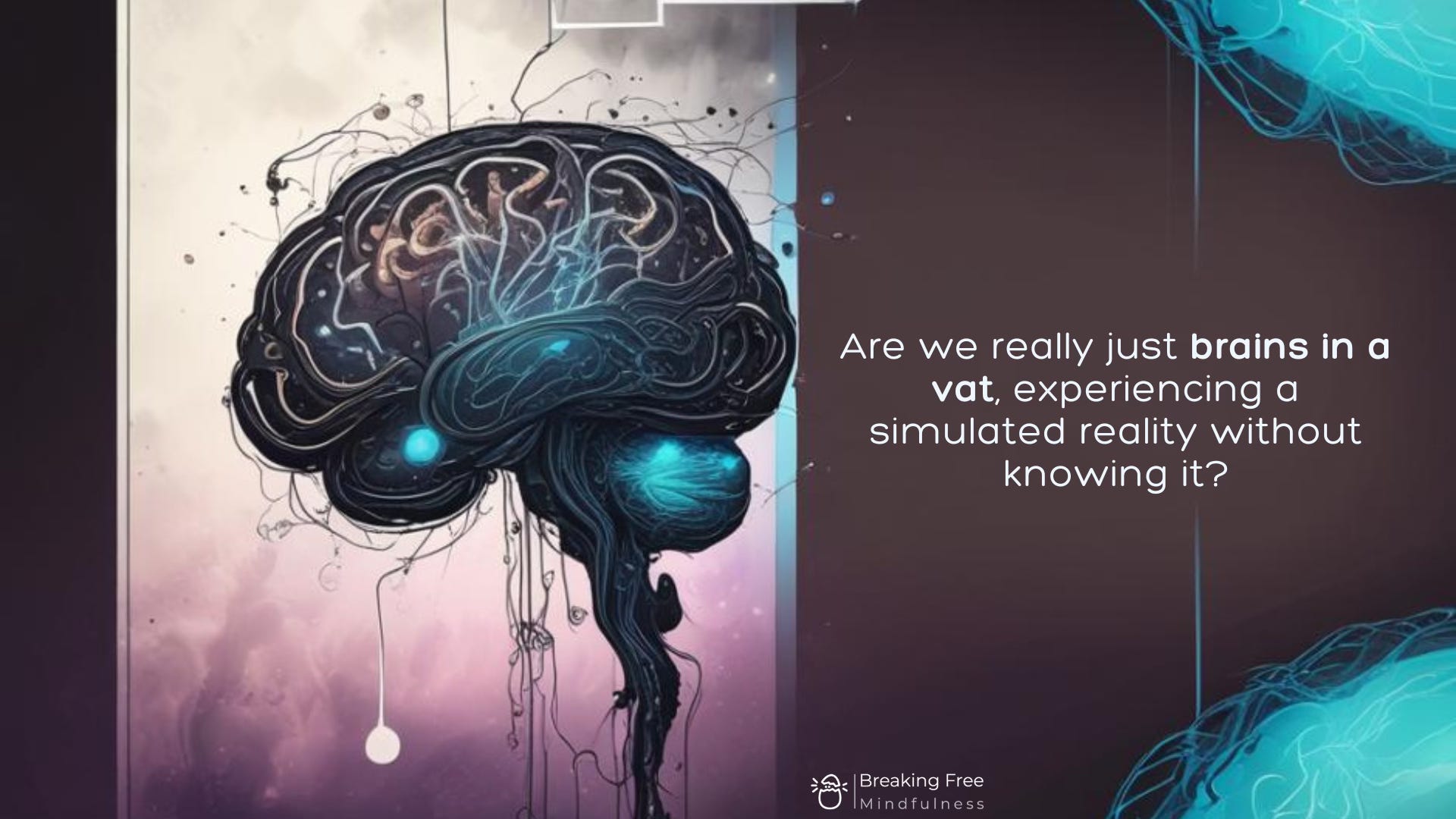
There is a classic philosophical thought experiment, the “brain in a vat.” To wit: imagine your entire reality is a simulation created by a computer; essentially your brain is floating in a vat, receiving electrical signals that produce the perception of a complete external world, even though it’s not real. Kind of like The Matrix, right?
Your first reaction might be “that’s crazy,” but is it? How would you know?
This might sound like a philosophy class hypothetical or science fiction, but modern neuroscience suggests that, in a very real sense, we are living in a constructed reality. The brain isn’t just a passive receiver of the world–it’s an active creator of experience, constantly interpreting, predicting, and filling in gaps. In fact, some researchers argue that what we perceive is less about raw sensory input and more about the brain’s best guess at what reality should be.
Your Brain, the Prediction Machine
It’s worth a digression here on Bayes’ Theorem, which some of you may be familiar with, and others perhaps not. It has to do with probability and prediction. Most people think of probability as something fixed–like rolling a die and knowing there’s a 1 in 6 chance of landing on any given number. But Bayes’ Theorem is different. Instead of treating probabilities as static, it treats them as something that updates as new information comes in.
This idea is crucial in many areas–especially when interpreting medical tests, where misunderstandings are surprisingly common. Here’s what I mean.
I recently had a colonoscopy (I know, TMI, but you should be getting one too), but maybe you’re one of the many people who fear that test, or more truthfully, the prep for it. Let’s say you opt for the Cologuard test instead to avoid that. In that test, you mail a, ahem, sample in for analysis.
According to the latest data, the test has a sensitivity of 94% (correctly identifies cancer if it’s there) and a specificity of 91% (correctly says you don’t have cancer if you don’t). Sounds solid, right? You might think that if you test positive, you have a 94% chance of having cancer. That’s scary, but it’s wrong.
Bayes’ Theorem says you need to consider the context - in this case, the base rate of colon cancer in a population. For the average person, the prevalence of colorectal cancer is about 0.3% (3 in 1,000 people). So, what are the actual odds you actually have cancer if you get a positive result?
Out of 10,000 people:
About 30 will actually have colorectal cancer. With 94% sensitivity, the test catches 28 of those 30 (true positives) but misses 2 (false negatives).
About 9,970 people won’t have cancer. With 91% specificity, 9,073 of them will correctly get a negative result—but 897 will get a false positive.
So, if you test positive, the chance you actually have cancer is:
28 true positives ÷ (28 true positives + 897 false positives) ≈ 3.0%.
Yep, even with a positive result, the odds you have cancer are only about 3%. You may have scared yourself to death for nothing, and you’ll need a colonoscopy anyway to confirm it. So you can see that without considering base rates (how common or rare something is), test results can be seriously misleading.
This is why Bayesian reasoning matters: our intuitive approach to probability often overlooks the impact of base rates and leads us to overestimate the significance of a single test result.
(steps off soapbox)
Anyway, this kind of probabilistic thinking applies far beyond medical tests—it’s how our brain constantly updates its model of the world based on imperfect, noisy data. In fact, your brain doesn’t just take in data like a camera or microphone—it builds a model of the world and updates it based on what it expects from prior information. This idea, known as the Bayesian Brain Hypothesis, suggests that perception is a process of constant prediction and correction.
Think about it - for all intents and purposes, you are sort of a brain in a vat. The brain is sitting in darkness inside the skull, and it’s getting electrical signals that start out as inputs from the senses, modified by its internal thoughts. It has to make educated guesses about what you’re seeing, hearing, and feeling. When it gets new sensory information, it checks how well that data fits its predictions. If reality doesn’t match expectations, your brain adjusts–or sometimes, it ignores the mismatch entirely.
Experiments
Here are some examples to make the point:
The Hollow Mask Illusion: When you see a concave mask (like the inside of a plastic face mask), your brain insists on seeing it as convex—because in everyday life, faces are always convex. Your perception bends reality to fit expectations. Check it out here.
Phantom Touch & Sensory Remapping: In experiments where participants wear VR headsets and see a fake hand being stroked while their real hand remains untouched, they often feel the touch on their actual hand. Their brain rewires its expectations of where their body should be. In effect, the brain prioritizes visualinformation over proprioception (the sense of body position)
Sensory Substitution: Blind individuals trained to “see” using a device that converts images into vibrations eventually start processing the vibrations as vision. Their brain rewires itself to create sight out of something that isn’t visual at all.
What these studies show is that perception is highly flexible, and sometimes, entirely misleading.
AI, VR, and the Future of Reality Manipulation
The idea that reality is a brain-generated construction has become even more relevant with artificial intelligence and virtual reality. AI-driven deepfake technology can create faces and voices that never existed, making it harder to distinguish real from artificial. Meanwhile, VR systems don’t just simulate environments–they convince your brain that they are real.
For example, studies on VR users show that people who experience a virtual height simulation often develop a real fear of falling, even though they know they’re standing safely on the ground. VR can also induce a sense of bodily ownership over virtual avatars, even if the avatar looks nothing like the user. The brain can be tricked into believing that a digital body is its own, demonstrating how plastic and adaptable our sense of reality really is.
As AI and VR technologies advance, the line between the physical and the virtual continues to blur. Could we one day live fully immersive, AI-generated realities that feel as real as our waking lives? We may not be far off from that future.
The Simulation Hypothesis: Are We Already in One?
This brings us back to the age-old question: If our brains create reality rather than simply perceiving it, how can we ever be sure what’s truly out there?
One of the most provocative modern takes on this question is the Simulation Hypothesis, popularized by philosopher Nick Bostrom. Bostrom argues that if technology continues to advance, civilizations will eventually have the ability to run highly sophisticated simulations of conscious beings. If even one advanced civilization runs such simulations, there could be countless simulated realities for every “real” one. Statistically, it becomes more likely that we are living in one of these simulations rather than in base reality.
Critics, however, argue that the Simulation Hypothesis rests on assumptions we cannot verify. For instance, it assumes that consciousness can be fully replicated by computational processes, which remains an open question. Others point out that even if advanced civilizations can create simulations, it does not necessarily follow that they would do so at scale. Moreover, there is currently no empirical evidence that our reality is a simulation–and unless we uncover clear “glitches” or evidence of external intervention, the hypothesis remains speculative and unfalsifiable. Still, the question lingers: If everything we experience is filtered through our brains, how can we ever be certain that reality isn’t just an illusion?
Living with an Uncertain Reality
So, where does this leave us? Should we freak out? Probably not. Even if we’re brains in vats, we still have to pay taxes and take out the trash. 😄
But seriously, understanding that reality is, at least partly, a mental construction can actually be pretty liberating. It’s a reminder that our view of the world isn’t fixed, and sometimes, it’s worth questioning our assumptions. Just because your brain is telling you one thing doesn’t mean that’s the whole story.
It also means other people’s realities might be just as weird, and as valid, as your own. The next time someone sees the world differently, maybe cut them a little slack—their brain’s just running a different simulation. 😇
And hey, if reality turns out to be one big simulation, maybe we can hope for an upgrade–preferably one without annoying people in it. 😉
-Scott