
Beyond Mount Stupid

🎧 Audio Version Available
Prefer to listen? I recorded an audio version of this piece, with a bonus meditation at the end.
A Meme With a Mountain
A year or so ago, I wrote a short post about the Dunning–Kruger effect. At the time, I had just sketched the surface of the idea, but I kept thinking there was more to say, especially about what happens on the far side of the curve.
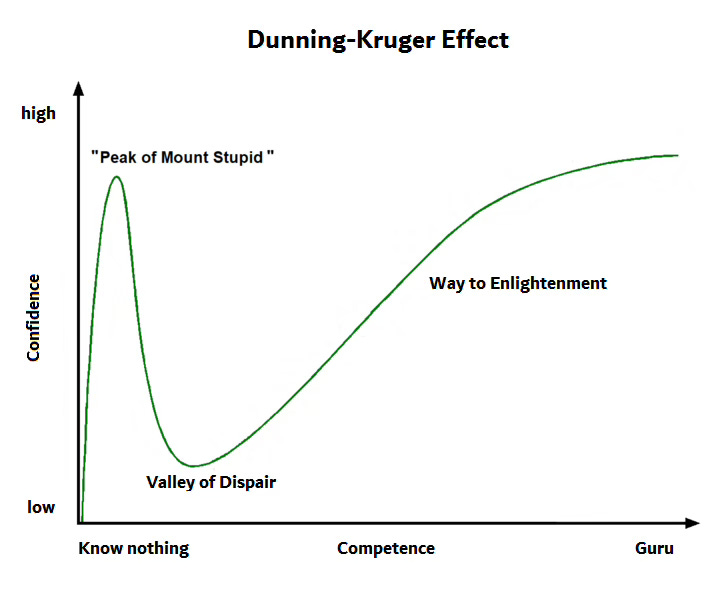
If you’ve been online in the last decade, you’ve probably seen the meme: the chart above with a peak labeled Mount Stupid, a deep valley of despair, and then a gradual climb to something called the “slope of enlightenment.” It’s often passed around as a shorthand for the Dunning–Kruger effect, which comes from a 1999 paper by psychologists David Dunning and Justin Kruger.
The gist of the paper: people with little knowledge or skill tend to dramatically overestimate their competence, while experts, oddly enough, are more likely to underestimate themselves. (The original study involved everything from logical reasoning tests to evaluating humor.)
The meme is funny, but it’s also misleading. That curve doesn’t actually appear in the study. Dunning and Kruger didn’t sketch a neat little mountain. But the image persists because it captures a familiar human truth: people with just a little knowledge and an axe to grind are dangerous - overconfident in their rightness even though they really don’t know what they are talking about.
Even a cursory look at our fellow humans will reveal many examples of that behavior. What interests me more, though, isn’t the meme’s “Mount Stupid” peak. It’s the far side – what we might call the humility of expertise.
Because when you’ve been at something long enough, you realize how complicated it really is. In the technical field I work in, the “end of the road” has been predicted more or less continuously for the past several decades. It never comes. Something new, something unexpected always emerges.
The same is true when I turn inward. The more I pay attention to my mind, the less I I understand it. It just is, in a way that seems to be beyond explanation.
There seems to be a hidden vastness beyond every question.
Every seeming fact seems to be not so factual after all.
For me, on the far side of Dunning–Kruger isn’t just expertise–it’s wonder. A kind of awe at the depth of things, the sense that knowledge doesn’t collapse the world into certainty but opens it up into something immeasurably larger.
And this isn’t just an academic curiosity. It shows up everywhere in real life.
Hidden Vastness
Think about work. Often early in a new role, confidence precedes ability. You’ve learned the basics, you know the lingo, and you feel like you’re crushing it. Then comes the valley–when the complexity hits you, when the problems don’t fit neatly into the models, when you realize you don’t even know what you don’t know. That’s humbling. But stick with it, and something shifts. You start to develop a deeper sense of perspective, not because you’ve solved everything, but because you know the terrain is bigger than you thought.
That’s the real gift of experience: not mastery as in “I’ve got this nailed,” but mastery as in “I know how little I know, and I can still move forward.” It’s a kind of earned humility.
And it doesn’t just apply to careers. Relationships, health, politics, even self-understanding–the more seriously you engage, the less certain you become. And yet, that uncertainty is exactly what makes growth possible. How can you learn if you think you know everything? And who on earth would want to engage with you if you come across that way?
“I would rather have questions that can’t be answered than answers that can’t be questioned.” - Richard Feynman
Which, ironically, brings us full circle. The Dunning–Kruger effect is usually invoked as a jab at the clueless. But what if it’s also a reminder to stay curious? To notice when we’re on Mount Stupid, to accept the valleys when they come, and to embrace the vastness waiting beyond them?
And of course, mindfulness helps here too.
Notice… when you’re clinging to certainty
Notice.. when your ego gets a little thrill from being the “expert” in the room
Notice… when you’re tempted to shut down possibilities because you’ve already “figured it out.”
That kind of noticing doesn’t make us less skilled at what we do; it makes us more human in how we do it. In a career, it can mean the difference between plateauing early and continuing to grow. In leadership, it can mean listening with openness instead of defending your own authority. In daily life, it can mean finding humility in relationships instead of doubling down on being right.
Because the far side of Dunning–Kruger isn’t just technical expertise. It’s a mindset: a willingness to admit what we don’t know, to remain teachable, to stand in awe of complexity instead of trying to conquer it.
And maybe that’s the real slope of enlightenment. Not mastery in the sense of “having arrived,” but the ability to keep moving with curiosity, humility, and a sense of wonder.
Socrates put it best:
“The only true wisdom is in knowing you know nothing.”
That’s the side of the curve worth climbing toward.
-Scott
🎧 Thanks for reading! If you want to hear this in my own voice, and listen to a short spoken-word piece / meditation not included above, you can listen to the audio version at the top of the article. The meditation starts around 6:23.